
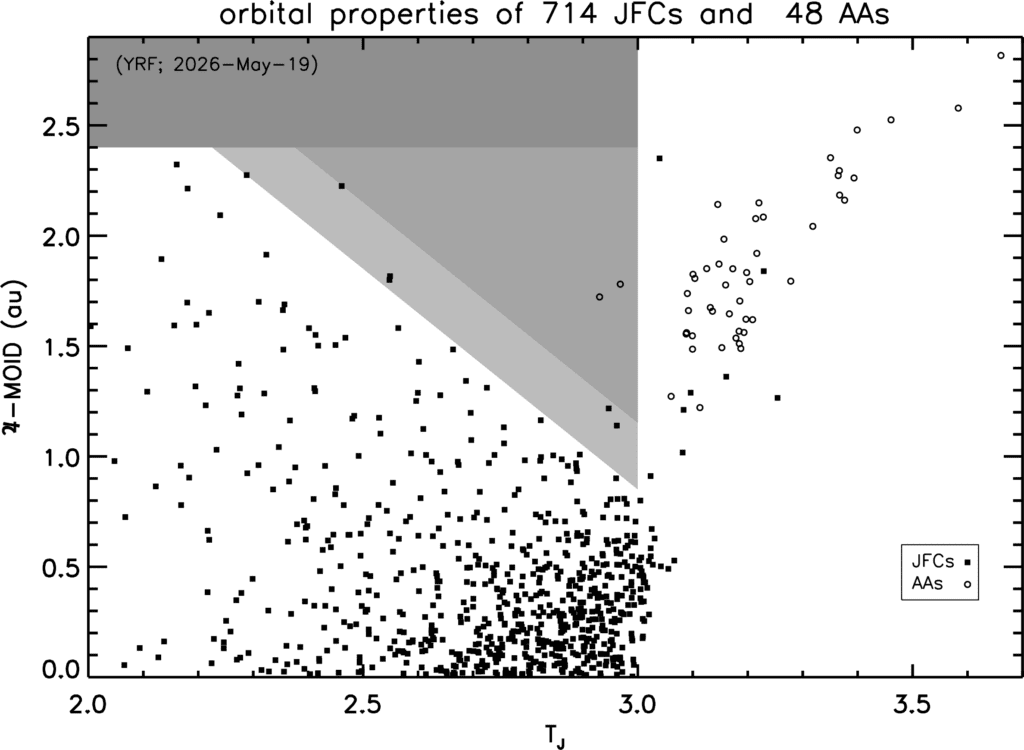
This is a scatter plot showing the Tisserand invariants TJ and MOIDs with Jupiter MJ for the Jupiter-family comets (JFCs) listed on my other page.
As the plot shows, most JFCs (the black squares) have MOIDs with Jupiter than are less than 1 au. Relatively few have MOIDs as high as 1.5 au, and even fewer above 2.0 au. There are no known JFCs with MOID above 2.4 au (dark grey rectangle).
The plot also shows objects known as Activated Asteroids (AAs; also known sometimes as Main Belt Comets, MBCs). The AAs (open circles) reside in the upper-right part of the plot with un-comet like Tisserands and relatively high Jupiter-MOIDs.
It is interesting to note that there are no JFCs in a triangular region (smaller grey triangle) between Tisserands ~2.4 and 3.0 and MOIDs ~1 to 2.4 au. This triangle has been placed completely by eye. It’s not a fit! The diagonal bound of the triangle is defined by MJ = -2TJ + 7.15.
Notes about some oddball objects:
- The two AAs within that grey triangle are both high-inclination objects, and they have large MOIDs that suggest they aren’t JFCs:
- P/2015 VP51 (activity reported by Frissell et al. 2024; MPC link)
- P/2016 P1 (though it has only an 11-day arc; MPC link)
- The JFC with both high TJ (above 3) and high MJ (near 2.4 au) is a high-inclination (30º), modest-eccentricity (0.39) object:
- P/2017 S8 (MPC link)
- The JFC with very high TJ (above 3.2) all by itself has a very short period, Earth-crossing orbit:
- 501P/Rankin (MPC link)
- There are 4 other JFCs with high TJ (above 3.05) that are within the cluster of AAs. Three of these are possibly actually AAs, but they have eccentricities just higher than my cutoff of 0.35.
- 477P/PANSTARRS (MPC link)
- P/2010 LH15 (activity reported by Chandler et al. 2023; MPC link)
- P/2016 UU121 (activity reported by Sedaghat et al. 2024; MPC link)
- The fourth object is 107P/Wilson-Harrington, an NEO so not within the MB.
Those 6 JFCs within the light grey trapezoid (whose lower boundary is defined by MJ = -2TJ + 6.85) are: 199P/Shoemaker 4, 219P/LINEAR, 347P/PANSTARRS, 451P/Christensen, P/2009 Y2, and P/2018 A5.